Trust AC
Topic-specific guidance
Neighbour noise, vibration and outdoor units needs its own estimate logic because neighbour noise, vibration, mounting and night-time outdoor-unit placement checks. The useful first step is to connect the customer's room, evidence, constraints and budget before comparing equipment, dates or written scope. Treat any missing photo, route detail or permission note as an estimate risk rather than a small admin gap. That discipline keeps the article useful for customers and traceable for the team reviewing the enquiry later.
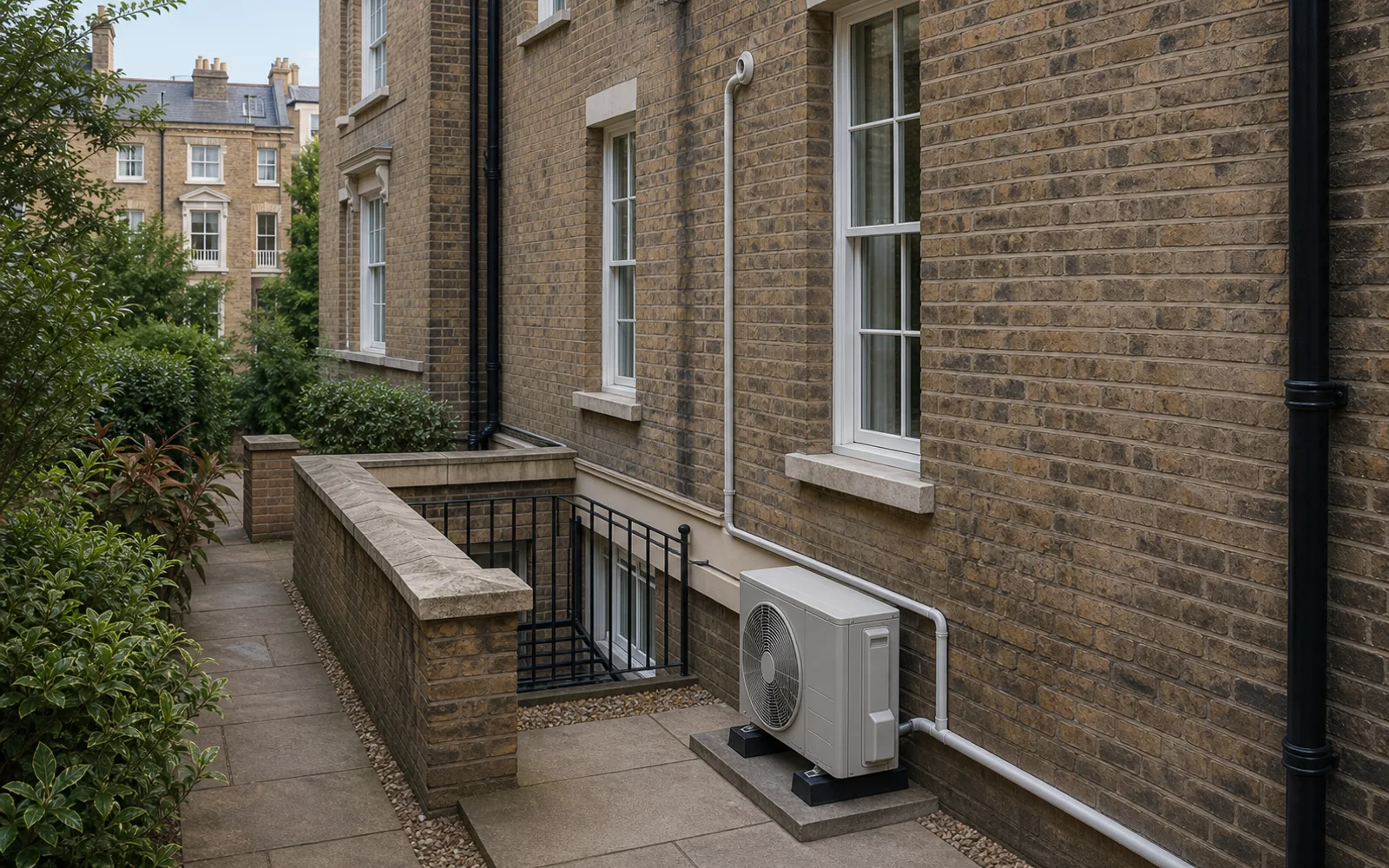
Outdoor-unit placement should be judged from the neighbour and night-time perspective, not only from the easiest pipe route. The customer may accept the sound, but the useful question is where the unit sits relative to bedrooms, boundaries, lightweight walls, shared alleys and places where vibration could travel.
Useful evidence includes photos from the proposed outdoor position back towards windows and boundaries, wall construction, bracket or base options, drain discharge, access for servicing, distance to neighbours and whether the unit may run at night for bedroom cooling or winter heating. A short route video is often more useful than a close-up of the condenser.
The quote should say whether the outdoor unit is wall-mounted, ground-mounted or placed on a frame, and whether anti-vibration measures, drainage and service access are included. If planning or neighbour sensitivity is uncertain, the estimate should carry that caveat rather than burying it after equipment is selected.
The risk is choosing the shortest route and discovering later that noise, vibration or appearance creates a dispute. A technically tidy installation can still be the wrong installation if the external position is not socially and practically workable.
When Neighbour noise, vibration and outdoor units is used in the enquiry form, pair the question with the target room, preferred temperature, daily use pattern, budget boundary, outdoor-unit option, access limits, noise sensitivity, drainage route, controller expectation, service access and any permission constraint. That gives the estimator an auditable set of assumptions instead of a single isolated topic.
Why complaints are usually about vibration, not volume
Most neighbour problems with outdoor units are not about how loud the fan is. They are about a low-frequency hum that carries through structure rather than air, and that is a mounting question. A unit bolted rigidly to a party wall, or to a lightweight wall that can flex, transmits compressor vibration into the building itself.
That is why a system can measure acceptably at the boundary and still be intolerable in the bedroom the other side of the wall. Anti-vibration mounts, a bracket fixed into solid masonry, and — where the wall is shared or hollow — a ground-mounted or free-standing position instead, are the usual fixes, and they are far cheaper before installation than after.
The times of day that decide the outcome
Background noise falls sharply at night, so a unit that is inaudible at 2pm can be obvious at 2am. If the system will run overnight — a bedroom in summer, or heating in winter — the night-time condition is the one that matters, not the daytime one.
Most equipment has a quiet or night mode that caps fan speed and compressor output. It reduces capacity slightly and is usually worth enabling anyway. Setting a schedule so the system is not running at full output in the small hours solves a surprising share of disputes before they start.
If a complaint is made anyway
Noise complaints about domestic equipment are usually raised with the council's environmental health team rather than with planning. They have a duty to investigate, and if they judge the noise to be a statutory nuisance they can require it to be abated — which for an outdoor unit generally means anti-vibration mounts, a different position, restricted running hours or, in the worst case, removal.
That threshold is about unreasonable interference with someone's enjoyment of their home, not a fixed decibel number, so the assessment takes in how loud it is relative to background, the time of day and how often it happens. Two things help if it gets that far: an installation that already meets the MCS 020 noise standard at the neighbour's nearest window, and a record of what was discussed and agreed before the unit went up.
Screens and enclosures, and what they actually do
The instinct when a unit is audible is to box it in, and a solid screen does help: it blocks the direct path of the sound and, if it is heavy and gap-free, meaningfully reduces what reaches a neighbour standing behind it. A slatted trellis with daylight through it does almost nothing, because sound passes through the gaps as easily as air does.
The problem is that the things which make a screen acoustically effective are the same things that choke the unit. Anything close-fitting or sealed traps the hot air the machine has just rejected, which it then draws back in, and the result is a quieter unit that runs longer and costs more — sometimes for long enough that nothing has been gained.
So treat a screen as a compromise to be designed rather than a fix to be added afterwards. Keep the clearances the manufacturer specifies on the intake and discharge sides, leave the top open, and put the barrier between the unit and the listener rather than wrapped around the unit. Where that is not possible, moving the unit is usually the better answer than enclosing it.
Talking to a neighbour before, not after
Neighbour agreement is not a planning requirement, but a persistent noise problem can be pursued separately as a statutory nuisance, and that is a much worse conversation than the one you could have had beforehand. Showing someone where the unit will go, what it sounds like and what hours it will run costs nothing.
If the wall is shared, or the unit will sit close to a neighbour's window or garden seating, it is worth putting the position in writing along with any mitigation — mounts, a quiet-mode schedule, or a different position entirely. Doing that early tends to be the difference between a neighbour who tolerates it and one who reports it.