Trust AC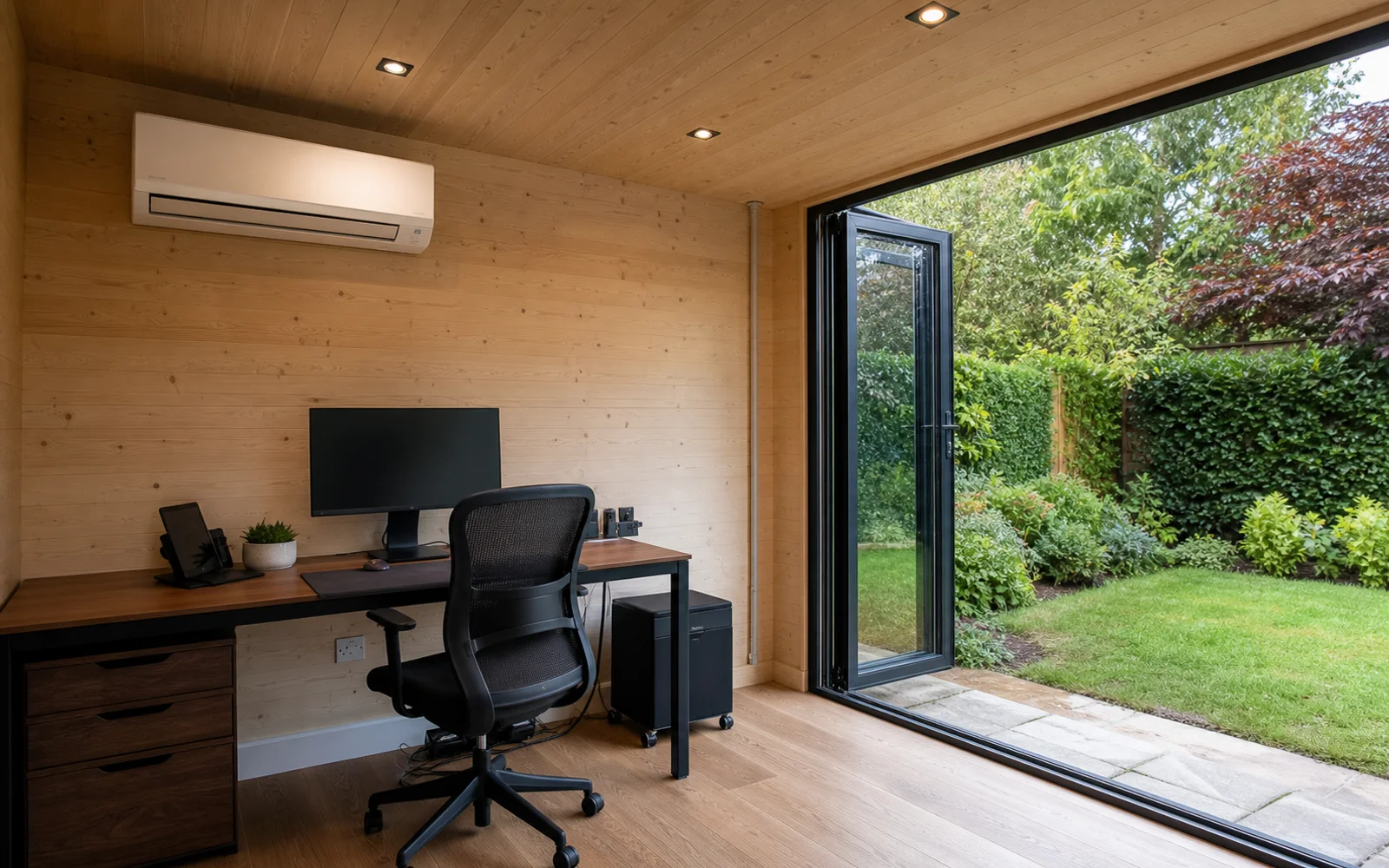
Topic-specific guidance
Garden office air conditioning needs its own estimate logic because garden office air conditioning planning for insulation, electrics, drainage and year-round comfort. The useful first step is to connect the customer's room, evidence, constraints and budget before comparing equipment, dates or written scope. Treat any missing photo, route detail or permission note as an estimate risk rather than a small admin gap. That discipline keeps the article useful for customers and traceable for the team reviewing the enquiry later.
Garden office air conditioning is usually about year-round work comfort in a lightweight building. The decision should check insulation, glazing, electrical supply and whether the office needs heating support as well as cooling.
Useful evidence includes the garden room construction, consumer-unit route, existing sockets, outside unit base, condensate fall, cable route, Wi-Fi or controller expectations and whether the building is used daily.
The quote should separate air conditioning equipment from any electrical upgrade or external cable work. It should also say where the outdoor unit sits so it does not obstruct paths, boundaries or future maintenance.
The risk is assuming a garden office behaves like an internal bedroom. Lightweight construction can overheat and cool quickly, and the electrical route can become the real project constraint.
When Garden office air conditioning is used in the enquiry form, pair the question with the target room, preferred temperature, daily use pattern, budget boundary, outdoor-unit option, access limits, noise sensitivity, drainage route, controller expectation, service access and any permission constraint. That gives the estimator an auditable set of assumptions instead of a single isolated topic.
A small building with an outsized load
A garden office is usually lightweight, largely glazed on one side, and sitting in the open with sun on the roof. That combination heats up far faster than an equivalent room inside the house, and cools down just as fast in winter, which is why so many end up with a plug-in heater in January and unusable by mid-afternoon in July.
It is also occupied by a person and their equipment all day. A laptop, a monitor or two and a body add a steady internal load that a spare bedroom never sees, and in a small volume that is a meaningful fraction of the total.
Insulation first, capacity second
The single biggest determinant of both comfort and running cost is how well the building was built. A well-insulated garden room with good glazing needs modest equipment and costs little to run; a thin-walled shed with a single-glazed slider needs more capacity and will cost more every hour it runs.
If the building is already up and underperforming, shading the sunniest glazing and improving the roof insulation are usually cheaper interventions than sizing air conditioning to overcome the problem. If it is not built yet, this is the moment to spend on the fabric.
Power is usually the real constraint
Most garden offices are fed by a single armoured cable from the house, sized for lighting, sockets and perhaps a small heater. Adding air conditioning may be within that supply or may not, and it depends on what the cable and the protective device were designed for — not on what is currently plugged in.
This needs checking properly rather than assuming, and it is the most common reason a garden office installation costs more than the equivalent room indoors. If the supply is inadequate, the cost of upgrading it can exceed the cost of the air conditioning itself, so it is worth establishing early.
The months it stands empty
A garden room is often used hard for part of the year and barely at all for the rest, and the empty months are when the damage happens. An unheated timber building with a laptop dock, a monitor and a filing cabinet in it will reach dew point on cold nights, and condensation forms on the coldest surfaces — windows, metal, the back of anything against an external wall.
The cheapest defence is to leave the system running in heating at a low setpoint through the winter rather than switching it off, which keeps the interior above the point where moisture condenses. Held at around ten to twelve degrees it costs little, and it is considerably cheaper than replacing warped joinery or equipment that has spent a winter damp.
Two things make that practical: a schedule so it is not relying on anyone walking down the garden, and the confidence that the outdoor unit will keep running unattended — which is another reason to mount it clear of the ground with drainage below, so meltwater in a cold snap does not freeze into the base of a machine nobody is checking.
Year-round use changes the specification
If the room is a workplace rather than a summer studio, the winter side matters as much as the summer side. A reversible unit heats the space quickly and far more cheaply than a plug-in electric heater doing the same job, which is often the strongest argument for air conditioning in a garden office rather than a fan and a radiator.
It also affects planning: a unit that provides heating can fall under permitted development, while a cooling-only unit needs planning permission. A pump on a building inside your garden is covered by the same permitted development right as one on the house — but it draws on the same allowance, which is one unit per property, or two if the house is detached. So if there is already a unit on the house, the garden office may need an application. If the building is close to a boundary, so if the building is close to a boundary or the property is listed or in a conservation area, that is worth confirming before ordering.