Trust AC
Topic-specific guidance
Inverter air conditioning explained needs its own estimate logic because how inverter air conditioning modulates output and why it changes comfort, noise and cost. The useful first step is to connect the customer's room, evidence, constraints and budget before comparing equipment, dates or written scope. Treat any missing photo, route detail or permission note as an estimate risk rather than a small admin gap. That discipline keeps the article useful for customers and traceable for the team reviewing the enquiry later.
An inverter system is usually chosen for steadier comfort, quieter part-load running and less abrupt cycling, not because the word alone guarantees low bills. The practical question is whether the room needs gentle long-running control or only occasional cooling.
Useful evidence includes room size, insulation, solar gain, intended hours, night use and whether the customer is sensitive to fan or compressor changes. These details decide whether modulation is a meaningful benefit or just a brochure feature.
The quote should name the model and explain the expected comfort benefit in that room. If a cheaper fixed-output or simpler system is being compared, the difference should be framed around control, noise and operating pattern rather than vague efficiency claims.
The risk is overselling inverter technology as automatic savings. Real performance still depends on sizing, airflow, clean filters, outdoor temperature, controls and how the customer actually uses the unit.
When Inverter air conditioning explained is used in the enquiry form, pair the question with the target room, preferred temperature, daily use pattern, budget boundary, outdoor-unit option, access limits, noise sensitivity, drainage route, controller expectation, service access and any permission constraint. That gives the estimator an auditable set of assumptions instead of a single isolated topic.
Varying output instead of switching on and off
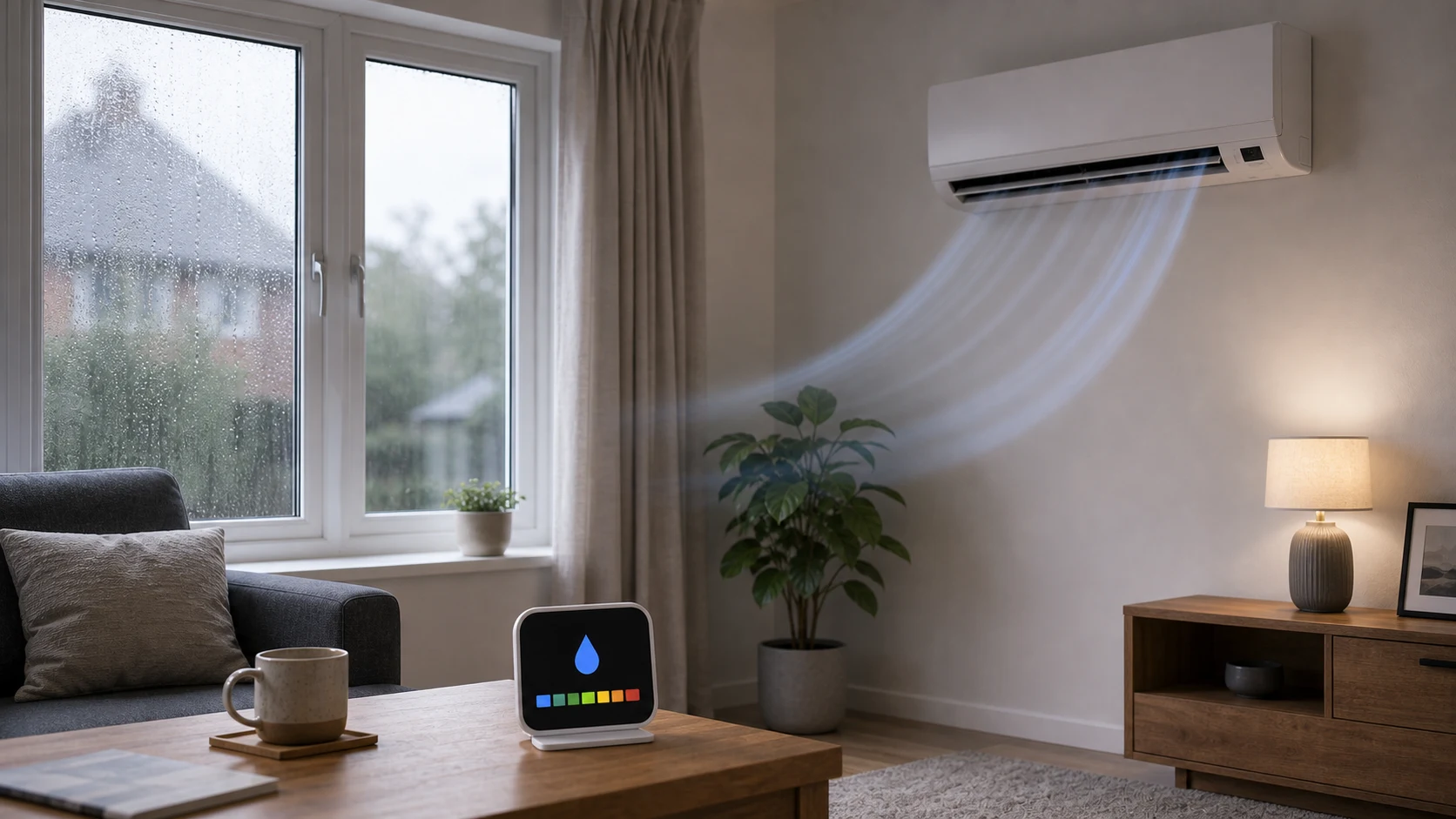
A non-inverter system has one speed: full. It reaches the set temperature, shuts the compressor off, drifts, then starts again at full power. An inverter system varies the compressor speed instead, running slowly and continuously once the room is close to where you want it.
That difference explains most of what people notice. Temperature holds steadier because the system is trimming its output rather than overshooting and undershooting. Noise is lower most of the time because the compressor and fans rarely need full speed. And running cost usually falls, because a compressor held at low output draws far less power than one repeatedly starting at full load.
Why oversizing hurts an inverter more than you would expect
An inverter is most efficient when it can settle at a low, steady output. A unit that is much larger than the room needs cannot do that: it satisfies the room almost immediately, then has to cycle anyway, which is precisely the behaviour the technology exists to avoid.
This is why 'buy bigger to be safe' is poor advice with inverter equipment. An oversized system tends to be noisier, less comfortable, worse at removing humidity — because short runs give the coil little time to condense moisture — and more expensive both to buy and to run. Getting the capacity close to the actual heat gain matters more here than it did with older fixed-speed kit.
What an inverter feels like to live with
The difference people notice first is not the electricity bill, it is the absence of events. A fixed-speed unit announces itself: the compressor starts, the room cools past where you wanted it, the unit stops, the room drifts back up, and it starts again. An inverter holds a temperature instead of repeatedly arriving at it, so the room stops having a rhythm you can feel.
It is also quieter for most of the time it is on, because for most of that time it is not running at full output. In a bedroom or a small office that matters more than any efficiency figure, and it is the part of the case for an inverter that a specification sheet does not convey.
Starting current, and why it matters on an older supply
A fixed-speed compressor starts by slamming to full speed, drawing a large surge of current for a moment. That surge is what makes lights dim briefly in older properties, and it is what an ageing consumer unit, a long supply cable or a shared supply notices most.
An inverter ramps up from zero instead, so the peak demand is much lower even where the running current ends up similar. In practice that makes it easier to add to a property whose electrical supply is already working hard, and it is one reason an inverter can sometimes be fitted where a fixed-speed unit of the same capacity would have meant supply work first.
It is not a substitute for the electrical assessment — the circuit still has to suit the load, and that is a question for the installer's electrician rather than a specification detail. But if you have been told the property's supply is marginal, it is worth asking whether the starting characteristics change the answer, because sometimes they do.
What to check before you buy on efficiency claims
Headline efficiency figures are measured across a range of conditions, so they reward exactly this steady low-output behaviour. They describe the equipment's potential rather than your result: a well-matched unit in a well-insulated room will approach it, and an oversized unit in a draughty room will not.
Worth asking your installer directly: what capacity have you sized this at and why, how quiet is it at the speeds it will actually run at rather than at minimum, and does the quoted figure assume the system also heats. The answers tell you more about the eventual electricity bill than the efficiency class on the box does.