Trust AC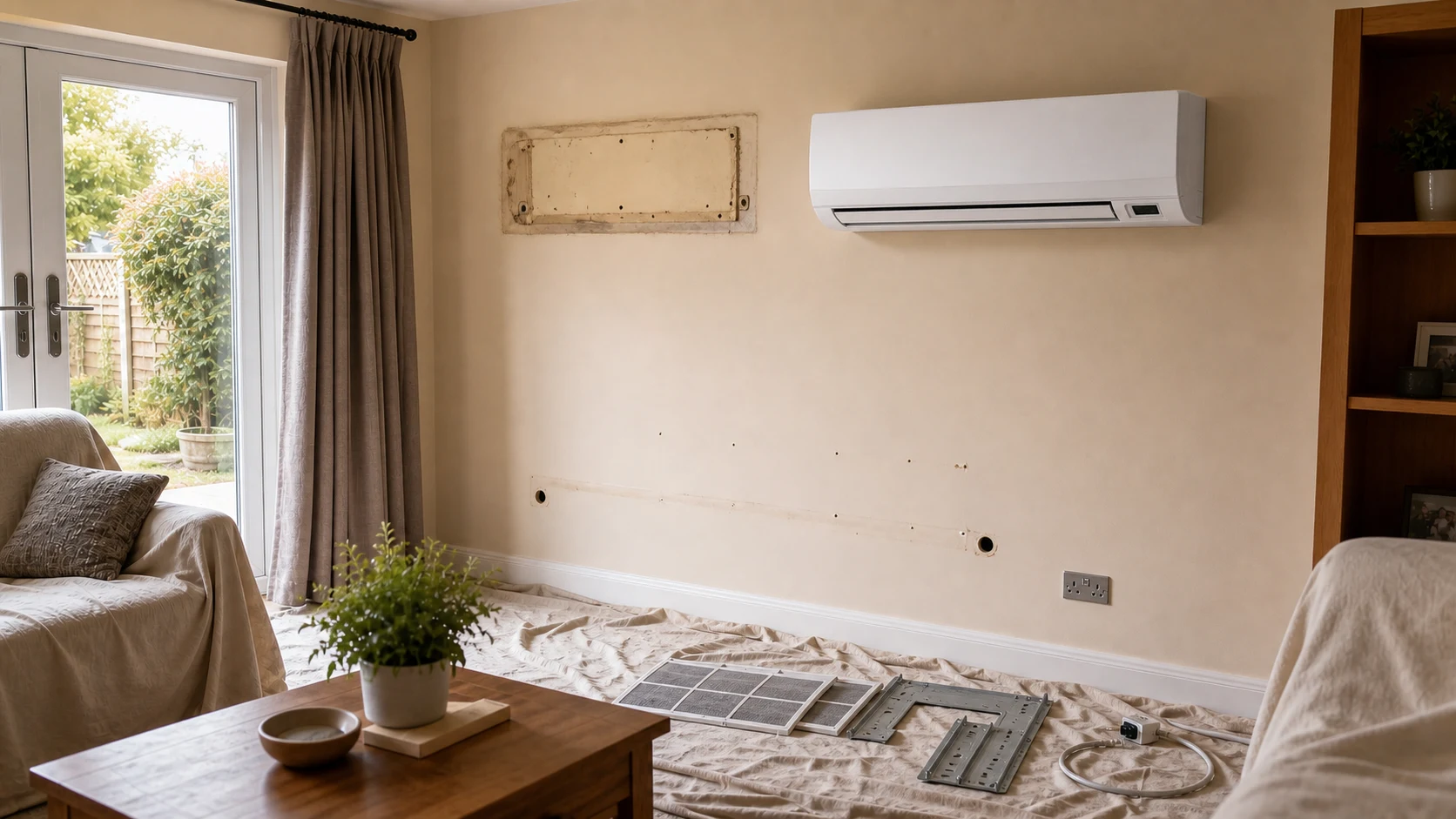
Topic-specific guidance
Replacing an old air conditioner needs its own estimate logic because how to think about replacing old indoor and outdoor air conditioning units. The useful first step is to connect the customer's room, evidence, constraints and budget before comparing equipment, dates or written scope. Treat any missing photo, route detail or permission note as an estimate risk rather than a small admin gap. That discipline keeps the article useful for customers and traceable for the team reviewing the enquiry later.
Replacement should start with what can safely be reused and what should be renewed. Old brackets, pipework, wiring, drains and refrigerant type all need checking before a like-for-like price is trusted.
Useful evidence includes model labels, controller errors, photos of both units, pipe route, isolator, drain route, service history and whether the system has leaked or been repeatedly topped up.
The quote should identify whether removal, recovery, disposal, new brackets, new pipework or electrical changes are included. Reusing old components should be a conscious decision, not an assumption.
The risk is pricing only the shiny new indoor and outdoor units. Hidden legacy issues can affect safety, warranty, refrigerant handling and the finished appearance.
When Replacing an old air conditioner is used in the enquiry form, pair the question with the target room, preferred temperature, daily use pattern, budget boundary, outdoor-unit option, access limits, noise sensitivity, drainage route, controller expectation, service access and any permission constraint. That gives the estimator an auditable set of assumptions instead of a single isolated topic.
Repair or replace is mostly a refrigerant question
For a unit that still runs, the honest decision usually turns on what is inside the pipes rather than on age. Systems installed before roughly 2004 often used R22, which was phased out of servicing in two steps: virgin gas from 2010, and reclaimed or recycled gas from 2015. Since then no R22 in any form may be used to top a system up. A leak in an R22 system is therefore not repairable in any practical sense.
R410A systems are still serviceable, but the gas has a high global warming potential and is being squeezed out by the F-Gas quota system, so it is getting steadily more expensive. Newer R32 equipment uses less refrigerant per kilowatt and is what almost any replacement will be. None of this makes a working R410A system urgent to replace; it does change the sums once a repair is needed.
What can be reused, and what cannot
The bracket, the wall penetration, the trunking and often the drain route are usually fine and save real money. The condensate pump, if there is one, is a wear item and is worth replacing at the same time rather than in a year.
Existing pipework is the contested one. It can sometimes be reused, but only if the diameters suit the new unit, the flares are sound, and it can be properly cleaned of the old oil — mineral oil left behind from an R22 system does not mix with the synthetic oil in modern equipment and will damage the compressor. Reusing pipework also tends to affect the manufacturer warranty. Ask the installer to tell you explicitly which they are proposing and why.
Do not just repeat the old capacity
It is tempting to fit the same kW as before, and it is often wrong. If the property has had loft insulation, new windows or an extension since the original install, the heat load has changed. Older units were also frequently oversized, which is why they cycled hard and dehumidified poorly.
A modern inverter unit sized correctly for the room today will usually be quieter and cheaper to run than a like-for-like swap, and the reassessment costs nothing but the time it takes to measure the room properly.
When repair is genuinely the better call
Not every fault on an older system points at replacement. Fan motors, control boards, capacitors, temperature sensors and the outdoor fan blade are all serviceable parts, and on a unit that is otherwise sound and using a current refrigerant, replacing one of them is usually a fraction of the cost of a new installation.
What tips it the other way is the compressor, a leak in pipework that is buried in a wall or a floor, or a system on a refrigerant that can no longer be topped up. In those cases the repair either costs a large share of a replacement or cannot be done properly at all, and money spent on it buys time rather than a working system.
The useful question to put to an engineer is not "can it be fixed" but "what is it likely to cost, and what else on this unit is near the end of its life". A ten-year-old system with a failed fan motor and a coil in good condition is worth repairing. The same system with a second fault a year later is telling you something, and it is worth listening the second time.
Disposal is not optional
Refrigerant must be recovered by an F-Gas certified engineer before the old unit is removed; venting it is an offence. The unit itself is waste electrical equipment and has to go through the proper route.
A quote should say who removes and disposes of the old equipment and that the cost is included. If it does not mention the old unit at all, that is a question to ask before you sign rather than a detail to discover on the day.
Keep the old system's paperwork until the new one is commissioned and working. The model numbers, the original pipe route and any service history all help whoever installs the replacement, and occasionally they settle a question about what is behind the wall that nobody can otherwise answer.