Trust AC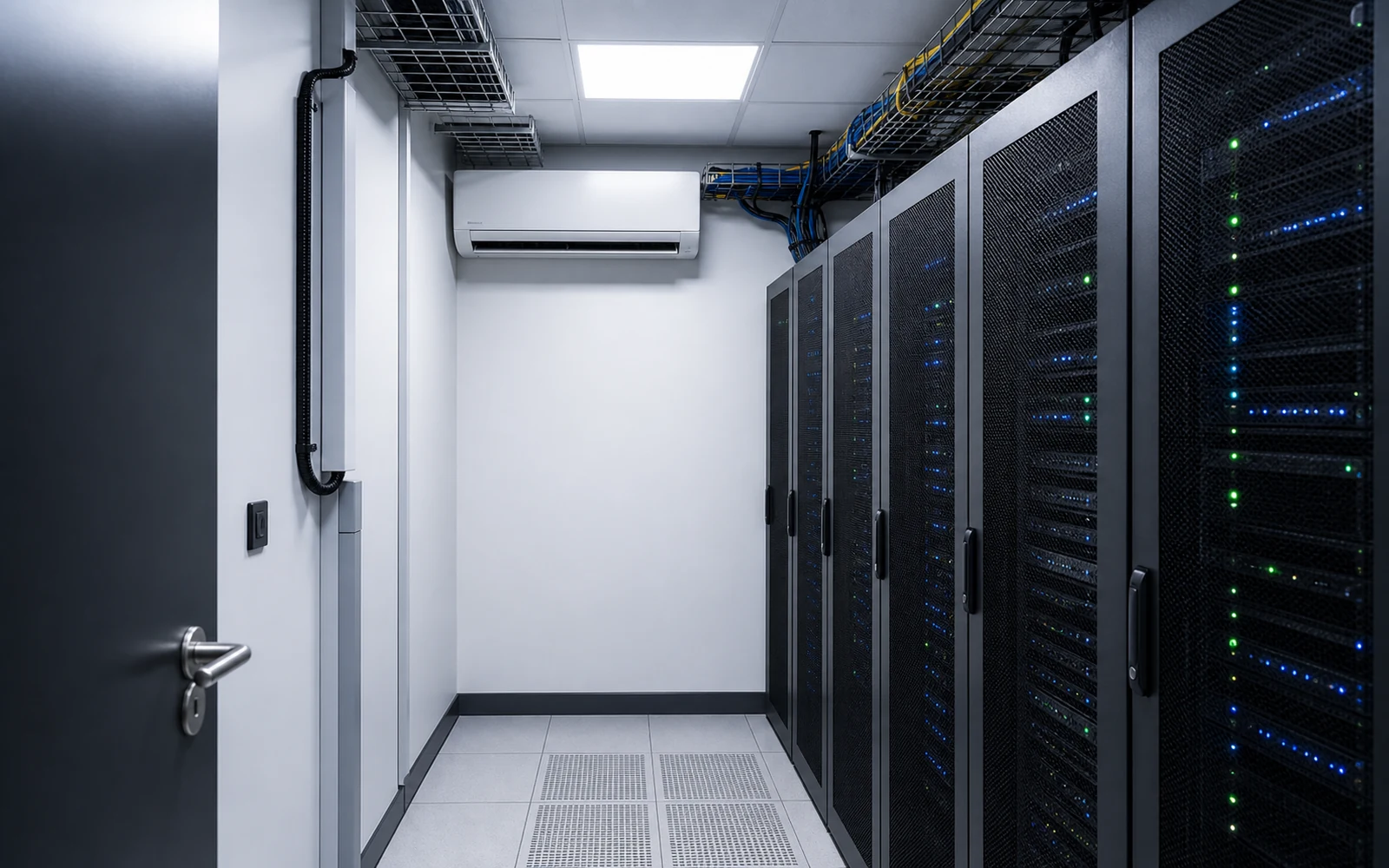
Topic-specific guidance
Server room and comms room cooling needs its own estimate logic because server room and comms room cooling basics for small business spaces. The useful first step is to connect the customer's room, evidence, constraints and budget before comparing equipment, dates or written scope. Treat any missing photo, route detail or permission note as an estimate risk rather than a small admin gap. That discipline keeps the article useful for customers and traceable for the team reviewing the enquiry later.
Server and comms room cooling is about continuity, not comfort alone. The load may run 24/7, and the cost of failure can be higher than the cost of a better design.
Useful evidence includes equipment heat, rack layout, room size, door policy, existing ventilation, alarm needs, redundancy expectations, power supply and whether the space is occupied by people.
The quote should state whether the design is ordinary comfort cooling or business-critical cooling support. It should not imply resilience, monitoring or redundancy unless those are explicitly included.
The risk is treating a comms room like a small office. Continuous heat load, blocked airflow and lack of fallback can turn a modest installation into a business risk.
When Server room and comms room cooling is used in the enquiry form, pair the question with the target room, preferred temperature, daily use pattern, budget boundary, outdoor-unit option, access limits, noise sensitivity, drainage route, controller expectation, service access and any permission constraint. That gives the estimator an auditable set of assumptions instead of a single isolated topic.
The load does not go away at night
A comms room is unlike any other space in a building because its heat load is almost entirely equipment and almost entirely constant. Electrical power going into the racks comes out as heat, near enough watt for watt, and it does so at three in the morning in January exactly as it does at midday in August.
That changes the specification completely. Comfort cooling is sized for occupied hours and outdoor conditions; this is sized for a steady internal load that does not care what the weather is doing. A unit that is fine for an office of the same floor area can be badly wrong here.
Sizing from the power draw, not the floor area
Start from what the equipment actually consumes rather than from square metres. Take the measured or rated power draw of the racks, add the uninterruptible power supply losses, add lighting and any people who work in there, and add whatever heat comes through the walls from surrounding spaces — which for an internal room is often warm on every side.
Then think about headroom. Sizing exactly to today's load leaves nothing for the equipment that will be added, and a room that is running at the limit has no time to recover during a fault. But a unit sized far above the load will short-cycle, which is hard on the compressor and poor at dehumidifying, so headroom is a judgement rather than a multiplier.
What happens when it fails matters more than efficiency
A single unit means a single point of failure. In a small room with modest kit, that may be an acceptable risk with a monitored alarm and a plan. Where downtime is expensive, two units each capable of holding the room, alternating so both stay exercised, is the usual answer — and it is much cheaper to plan for at installation than to retrofit.
Whatever the arrangement, temperature monitoring with an alarm that reaches a person is essential. The failure mode people miss is not a dramatic one: the unit stops, nobody notices, and equipment throttles or shuts down hours later. Also confirm the cooling is on a supply that survives whatever the rest of the building does, since a server room whose kit is on a UPS but whose cooling is not will overheat during exactly the event the UPS was bought for.
Humidity matters as much as temperature
Temperature gets the attention because that is what the alarm watches, but a comms room can sit at a perfectly good temperature and still be a bad environment. Air that is too dry raises the risk of static discharge when somebody works on the racks; air that is too damp condenses on the coldest surfaces in the room, which in a cooled space can be the cooling equipment itself.
Ordinary comfort air conditioning dehumidifies as a side effect of cooling and has no way to put moisture back, so a small sealed room under a constant load can end up drier than intended over a long run. That is usually acceptable in a modest comms cupboard, and becomes a real design question as the room gets more valuable.
The practical steps are modest: monitor humidity alongside temperature rather than temperature alone, keep the room sealed so it is not exchanging air with a damp corridor or an external wall, and if the equipment manufacturers specify a humidity range for the kit you are housing, put that range in front of whoever is sizing the cooling rather than assuming it will be met.
Practical details that decide whether it works
Air has to get from the unit to the front of the racks and back again. Blowing cold air at the back of a cabinet, or letting hot exhaust recirculate straight into the intake, wastes most of the capacity you paid for. Simple separation of intake and exhaust does more than extra kilowatts.
Drainage needs attention because the unit runs year-round, including through winter when nothing else in the building is producing condensate. And keep the room genuinely enclosed — a propped-open door to help with cooling usually just puts the load onto whatever is cooling the corridor.